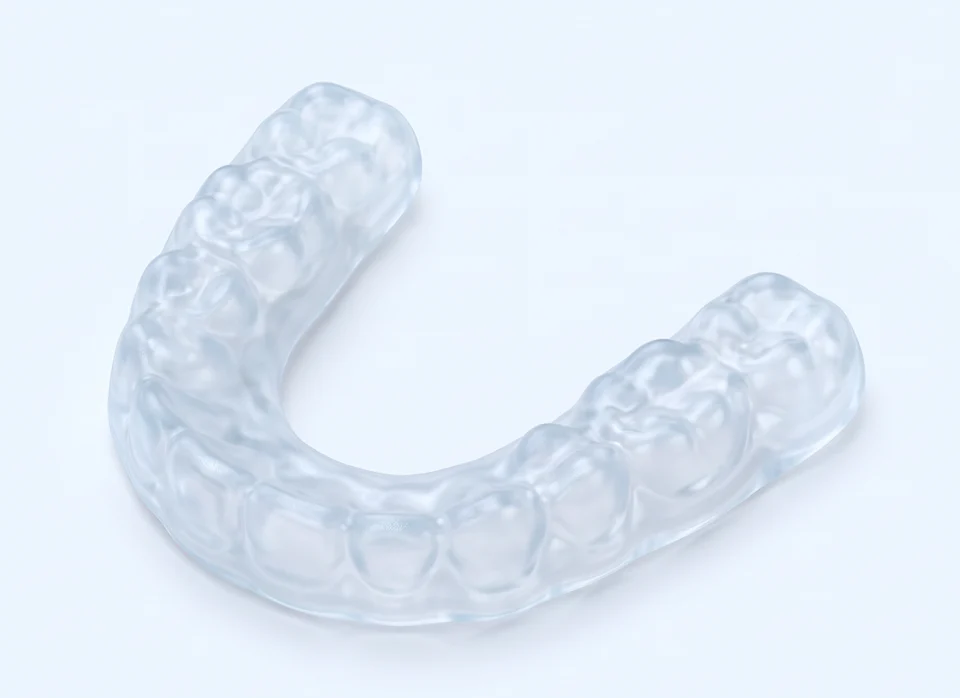
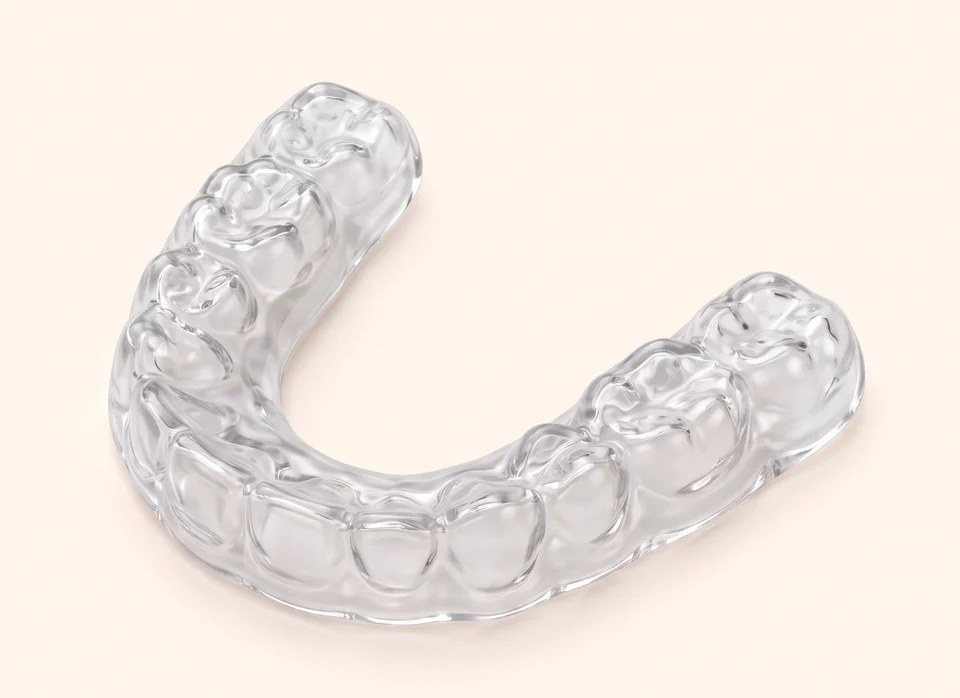
What the published evidence says about soft, hard/soft and hard acrylic occlusal guards, and how patient factors map to each material.
Last reviewed October 5, 2026 · Educational summary of peer-reviewed literature, not a clinical protocol. The choice of appliance is the treating dentist's.
Key points
No appliance material has been shown to stop bruxism. Systematic reviews find short-term reductions at most; occlusal guards are used mainly to protect teeth and restorations from the forces of grinding and clenching [5][10][11].
Hard acrylic has the most support where muscle activity and wear matter. It lowered night-time masseter activity in 8 of 10 patients in a crossover study [1], and harder materials wear less than thermoformed EVA in laboratory tests [15][16].
Soft EVA relieves short-term TMD pain about as well as hard acrylic[6][7][8], but raised muscle activity in half of patients in one small study [1] and wears fastest [15].
Dual-laminate (hard/soft) guards have little direct clinical evidence. Their rationale rests on material properties: a hard occlusal surface for wear, a soft inner surface for comfort.
For any material: cover the full arch, screen for snoring or sleep apnea, and follow up [19][21].
Selection by patient factor
Strength of evidence reflects the published studies, most of which are small.
Patient factor
Material most supported
Evidence
Heavy sleep bruxism or strong clenching; goal is lower muscle activity
Processed acrylic hard splint
Weak [1][3]; a 2024 meta-analysis found no material difference [2]
Protecting worn teeth, restorations or implants
Processed acrylic hard splint
Moderate for material wear (lab) [15][16]; expert opinion for clinical protection
Evidence: Matched hard splints for short-term TMD pain in a 200-patient RCT [6] and outperformed them at 4 months in one trial [7]. Lowered maximum bite force and improved sleep-quality scores over 2 months [4].
Cautions: Raised night-time masseter activity in 5 of 10 patients [1]; increased joint vibration [9]; highest wear and roughness of common splint materials in chewing simulation [15].
Most ordered1 mm soft EVA inside · 2 mm hard outside · illustration
Hard/Soft (2 mm hard + 1 mm soft EVA)
Comfort with a hard occlusal surface
Evidence: No dedicated clinical trials of hard/EVA laminates. The design combines a harder occlusal layer, which wears less than EVA in laboratory tests [15][17], with a soft inner layer for fit and comfort. In one trial a dual-laminate of a different construction (PETG with a TPU inner layer) performed like hard acrylic on joint vibration [9].
Cautions: Less adjustable than processed acrylic; a soft inner layer may allow slight tooth movement, so confirm fit at follow-up.
Evidence: Lowered night-time masseter activity in 8 of 10 patients [1]; largest EMG reduction among hard, soft and semi-soft in a 3-month trial [3]; PMMA is harder than PETG/TPU [17] and wears less than EVA [15][16]. Occlusal contacts can be adjusted chairside.
Cautions: Firmer feel; some patients need time to adapt. 3 mm and 6 mm thicknesses showed no EMG difference [14].
Full-arch coverage. Partial-coverage and over-the-counter appliances have been linked to anterior open bite and unwanted tooth movement [19][20].
Screen for sleep-disordered breathing. Flat-plane splints worsened the apnea–hypopnea index in some patients with obstructive sleep apnea [21][22][23].
Schedule follow-up. Check fit, occlusion and wear at recall, and replace worn appliances.
Children. Growth and erupting teeth complicate splint use; evidence in children is limited [12][13][25].
What the evidence does not show
No randomized trial has measured tooth wear as an outcome, so tooth protection is the accepted rationale rather than a proven result [10].
For chronic TMD pain, a 2023 BMJ guideline makes a conditional recommendation against reversible occlusal splints and a strong recommendation against irreversible ones [24].
Most comparisons are small and short; results on soft splints conflict depending on the outcome measured [1][7].
Questions dentists ask
Do soft night guards make clenching worse?
In some patients. In a 10-patient crossover study the soft splint raised night-time masseter activity in 5 patients, while the hard splint lowered it in 8 [1]. A 2024 meta-analysis found no overall difference between materials, with low to very low certainty [2].
Which material lasts longest?
In laboratory chewing simulation, EVA showed the most wear and roughness, while PMMA and polycarbonate wore least [15]. A systematic review of in-vitro studies found thermoformed materials wear most [16].
Is a soft splint as good as hard acrylic for TMD pain?
For short-term pain, yes in most trials: a 200-patient RCT found no difference between a hard flat-plane splint, a soft splint and self-care alone at 12 months [6].
Can a night guard affect sleep apnea?
A flat-plane splint that does not advance the mandible increased the apnea–hypopnea index by more than 50% in 5 of 10 patients with sleep apnea in one study [21]. Screen for snoring and sleep apnea first.
How thick should a night guard be?
Most are 3 mm. Increasing thickness from 3 mm to 6 mm did not change muscle activity [14], while thicker EVA absorbs more impact energy [18].
References
Okeson JP. The effects of hard and soft occlusal splints on nocturnal bruxism. J Am Dent Assoc. 1987;114(6):788-91. doi:10.14219/jada.archive.1987.0165
Nikolopoulou, et al. J Oral Rehabil. 2011;38(9):643-7. PubMed 21463349
Busse, et al. Management of chronic pain associated with temporomandibular disorders: a clinical practice guideline. BMJ. 2023;383:e076227. doi:10.1136/bmj-2023-076227
American Academy of Pediatric Dentistry. Acquired temporomandibular disorders in infants, children, and adolescents. The Reference Manual of Pediatric Dentistry. 2025:516-26. aapd.org
This page summarizes published research for dental professionals. It is not medical advice and does not describe the performance of any specific product. Diagnosis and appliance selection are the responsibility of the treating dentist.
Prescribe the material that fits the case
Soft, Hard/Soft and Processed Acrylic, designed from your intraoral scan. Night guards ship within 5 business days.